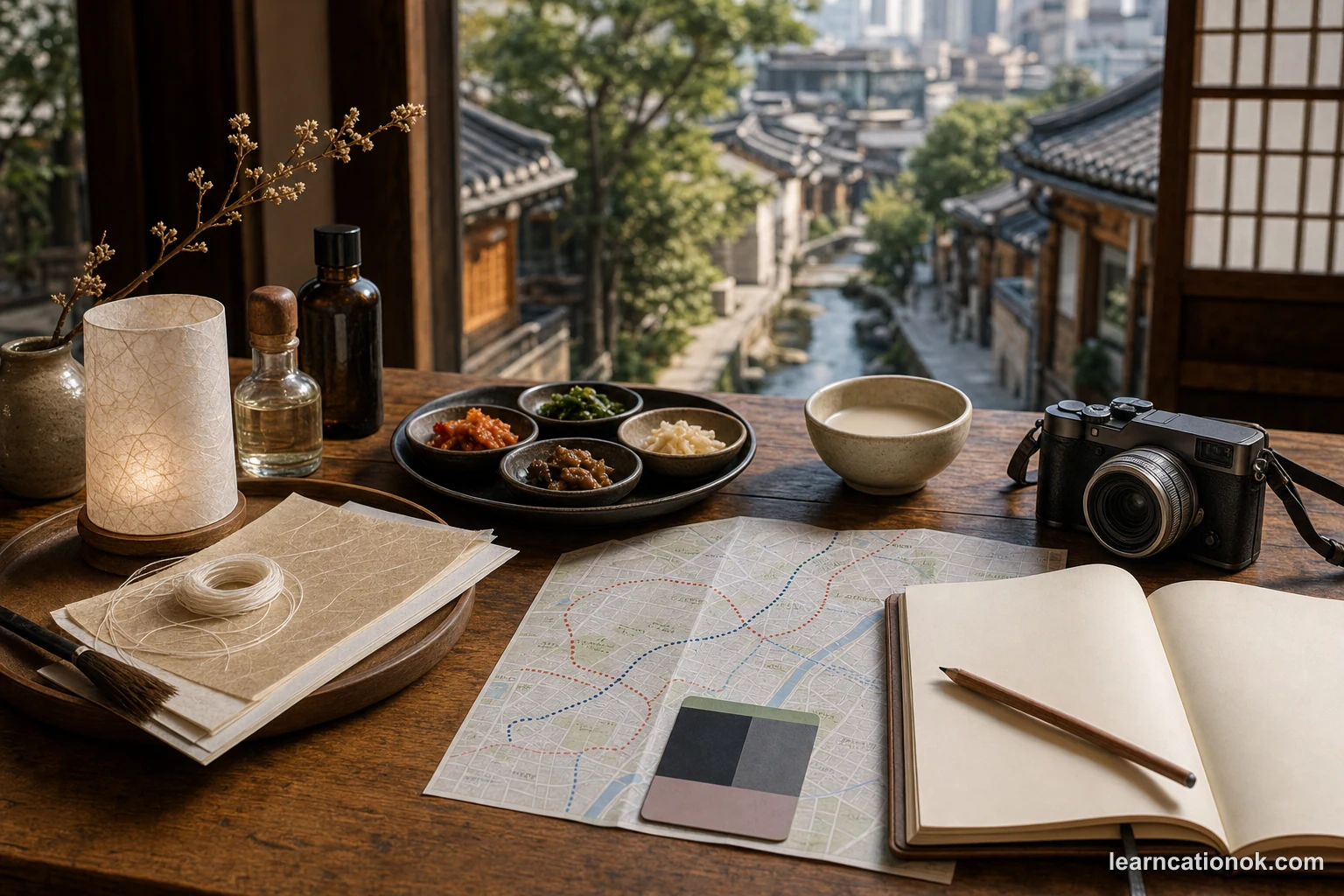
A first Seoul trip gets messy when every good idea becomes a reservation. The better move is to book one learning anchor, leave the weather-sensitive pieces open, and let the city become readable before the day gets crowded.
- Book one experience that teaches something: food, craft, scent, hanok sketching, or a guided walk.
- Leave palace, Bukchon, stream, and park windows flexible enough for weather, crowds, and first-day energy.
- Do not book every cultural slot in advance. Put the second good idea in Maybe List or Trip Draft.
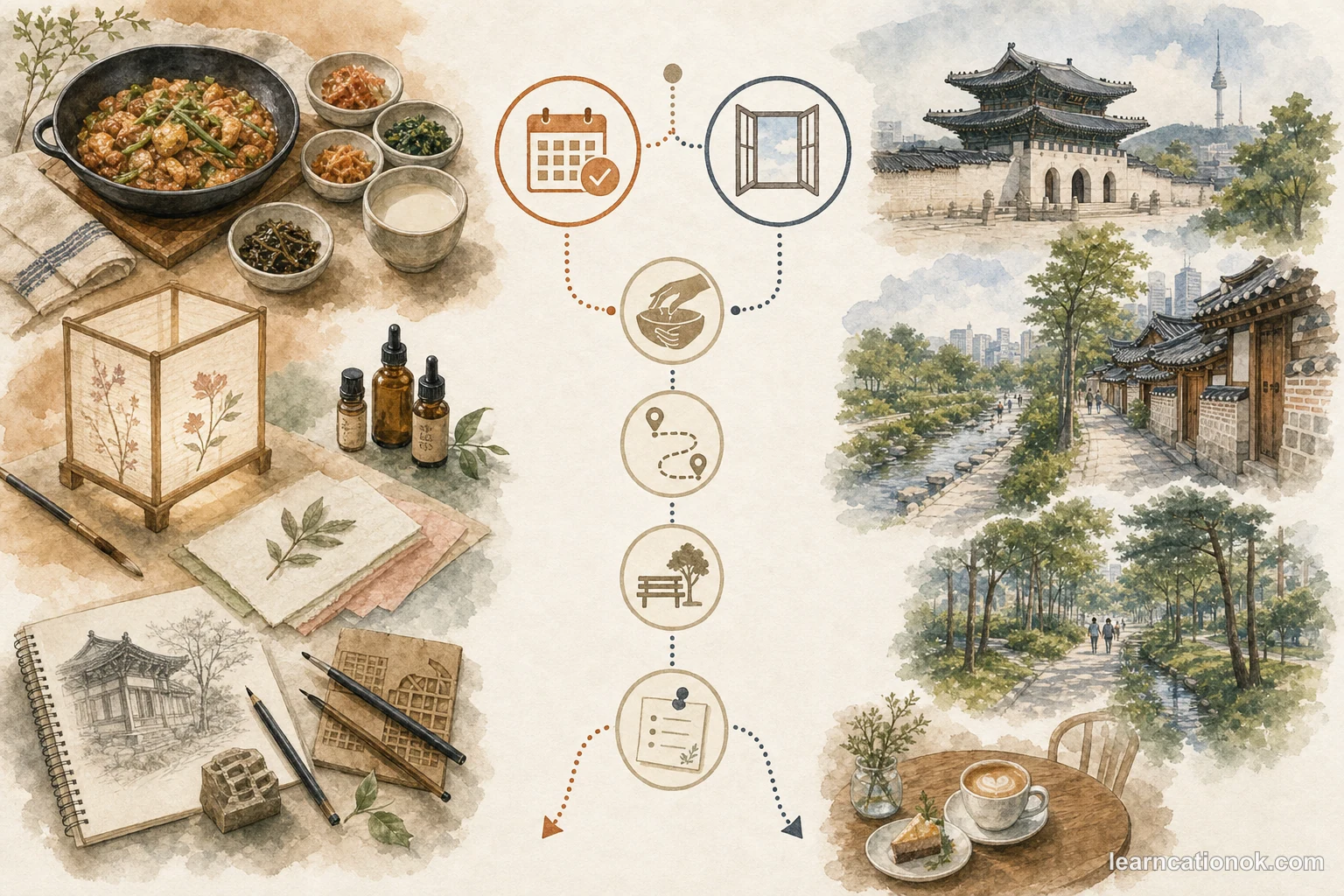
First Seoul planning fails when everything becomes fixed
Seoul rewards curiosity, but a first itinerary can get tight fast. A palace, Bukchon, Myeongdong, a cooking class, a craft workshop, a K-beauty stop, a river walk, and a night market all look reasonable when they sit alone in a tab.
Together, they become transfer friction, weather exposure, queue timing, and a day where the traveler is always late to the next correct idea. That is not a good first Seoul rhythm.
The Learncation OK rule is simpler: book one thing that teaches, leave one or two city windows open, and protect a soft reset.
Book one learning anchor, not a full culture calendar
The strongest pre-trip booking is the one that gives Seoul a center. A Korean home cooking table turns ingredients and banchan into vocabulary. A hanji paper lamp workshop makes tradition tactile. A scent studio shows modern Seoul through design, memory, and restraint.
This is why booking one class can be better than booking many famous places. The reservation gives you a start time, a host, a material, and a reason to slow down. Everything else can orbit that.
If you are unsure, choose the anchor by energy: cooking for warmth, hanji for quiet hands, scent for modern design, hanok sketching for neighborhood attention, makgeolli for a compact evening.
Book a guided walk only when context is the problem
Official Seoul walking tours can be useful when the city still feels unreadable. Visit Seoul describes city walking tours as guided, multilingual routes through Seoul's traditional areas, including palaces, fortresses, temples, and Bukchon-style neighborhoods.
That makes a guided walk a good booking when your stress is not the activity itself, but the route: where to start, what to notice, and how to connect the old-city layer without turning the morning into a random walk.
Do not book a guided walk and a long workshop on the same half-day unless both are close and short. Context needs room to land.
Leave palace and Bukchon timing open enough to behave well
Gyeongbokgung is a useful first-time reference point because it explains royal Seoul quickly. Bukchon is useful because it shows hanok streets and old-neighborhood texture. But neither should become a rigid box that forces the whole day to keep moving.
Bukchon especially needs respect. Visit Seoul frames it as a residential village, notes visitor restrictions in parts of the area, and asks visitors to keep noise down, avoid intrusive filming, and keep groups small. That is not a minor detail. It changes the planning logic.
Use palace and Bukchon as flexible windows around your booked anchor, not as obligations. If rain, heat, crowds, or tiredness show up, shorten the walk and keep the learning experience intact.
Leave the reset open, then use it on purpose
Cheonggyecheon and Seoul Forest are useful because they can rescue a day without asking for another booking. Cheonggyecheon runs through downtown Seoul and gives central neighborhoods a lower-noise path. Seoul Forest is stronger when the day needs more green space and less street compression.
These are not filler stops. They are the part of the plan that keeps the booked experience from becoming pressure. After a cooking class, walk lightly. After hanji, sit. After a guided route, stop proving the city and let the city settle.
A first Seoul day is successful when one booked anchor gives you a memory and one open reset gives you enough attention for tomorrow.
5 Seoul First-Trip Booking Decisions
These are planning anchors, not fixed operating details. Official Seoul sources were checked on June 8, 2026, but workshop schedules, tour reservations, palace hours, Bukchon visiting restrictions, weather, crowd conditions, transit, and meeting points can change. Confirm live details before building the day around one stop.
1. Book: Korean Home Cooking Table
2. Book: Hanji Paper Lamp Workshop
3. Book If You Need Context: Seoul Hanok Joinery Sketch Lab
4. Leave Open: Palace, Bukchon, and Cheonggyecheon Window
5. Book Lightly: Seoul Makgeolli Pairing Counter
Common Questions
A few direct answers for planning the page in real life.
What should I book before a first trip to Seoul?
Book one high-fit anchor before the trip: a Korean cooking table, hanji craft workshop, scent studio, hanok sketch session, makgeolli counter, or official guided walking tour. These work best when they give the day structure without taking over every hour.
What should I leave open in Seoul?
Leave palace timing, Bukchon walking, Cheonggyecheon, Seoul Forest, shopping, and cafe time flexible. These depend on weather, crowds, sleep, route friction, and whether the city already feels usable that day.
Is Bukchon Hanok Village something to book?
Usually no. Treat Bukchon as a respectful walking window rather than a full booked block, unless you are joining a specific official route or cultural program. Check current visiting-hour restrictions and keep group size, noise, and photography respectful because it is a residential area.
How many experiences should I book for a first Seoul day?
For most first-time visitors, one booked experience is enough for a first full day. Add one soft reset nearby. A second booking is only worth it if it is short, close, and clearly fits your energy.
- Visit Seoul - City Walking Tour Traditional CourseOfficial Seoul tourism source checked on June 8, 2026 for multilingual walking-tour framing, reservation context, and traditional-course planning.
- Visit Seoul - Bukchon Hanok VillageOfficial Seoul tourism source checked on June 8, 2026 for Bukchon residential-area context, visiting-hour restrictions, small-group guidance, and Anguk access.
- Visit Seoul - Cheonggyecheon StreamOfficial Seoul tourism source checked on June 8, 2026 for downtown stream, 24-hour promenade, rain-related access caveat, and station context.
- Visit Seoul - Gyeongbokgung PalaceOfficial Seoul tourism source checked on June 8, 2026 for palace-history context, English tour notes, museums, and first-time palace planning.
- Visit Seoul - Seoul ForestOfficial Seoul tourism source checked on June 8, 2026 for Seoul Forest station and soft-reset planning context.
- Seoul Metropolitan Government - Hanok VillageOfficial Seoul city source checked on June 8, 2026 for Namsangol and Bukchon hanok context and traditional-culture route framing.